

 Add as a preferred source on Google
Devil May Cry is yet another anime production of Netflix, adapted from Capcom’s famous action-adventure hack-and-slash video game, which premiered on April 3, 2025. The anime is developed by producer Adi Shankar and co-writer Alex Larsen, both known for creating Castlevania, with the help of Studio Mir, known for The Legend of Korra and X-Men 97. It can be safely said that the eight-episode series is loosely based on the third DMC game.
The official synopsis of the anime reads:
When a mysterious villain threatens to open the gates of Hell, a devilishly handsome demon hunter could be the world’s best hope for salvation.
It is the second attempt to adapt the legendary game into an anime, though it did great, but was not backed by Netflix. The expectations of the fans were touching the stratosphere before it was due to the love of the game and 2000s nostalgic music. Devil May Cry’s release was very well received by the critics and fans. With a stunning tonal shift in its latter episodes, the anime received a 92% critic score and an 80% audience rating.
In this article, we will examine the latest installment of the Netflix series, Devil May Cry, through four key factors- Animation, Story, Music, and Voice Acting, each on a scale of 1–10. In the end, the amalgamation of these factors will provide a final score.
Animation: 9/10
Studio Mir’s work on Devil May Cry was outstanding, but still a step behind its previous works, such as Witcher, My Adventures with Superman, and X-Men ’97. The series showed real energy in its fight choreography, the animation was really smooth and never felt clunky except in a few small fights, which is forgivable. The use of dynamic camera angles and stylized bloodshed tries to give the feel of the DMC games, but could be improved in future seasons. The bike chase scene in Episode 3 is a great example of how Dante uses his environment and weapons to create over-the-top but cool action sequences.

The series takes a dip when it comes to CG. The CG used on the boss demons and class Devil Trigger cannot be called a visual spectacle, and was no way near how it was portrayed in the games. While one could definitely argue the clunky CG makes the demons feel more “creepy,” it often clashed with the otherwise sharp 2D animation. We couldn’t be sure what the cause could be, but the studio’s previous work shows they can perfectly blend CG and 2D.
That said, Episode 6, The First Circle, animated by Studio La Cachette, is an absolute showstopper. The animation quality reaches top tier in this episode, as it beautifully paints the flashback story of two characters who are fighting the harsh reality of their worlds. Both worlds have different tone and animation style with jump cuts in between to help correlate both stories of Hell and Earth, giving the anime a different perspective from the game. It’s one of the best-animated episodes this year and pushes the series’ overall animation score close to perfect.
Story: 7/10
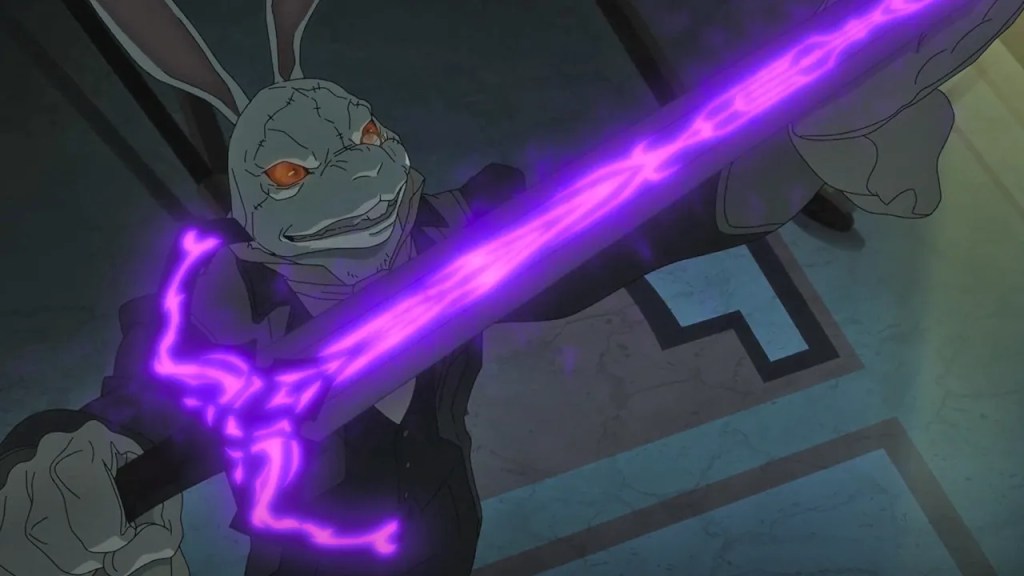
The plot follows the demi-human, Dante, who is a demon hunter caught in the crosshairs of the demon-hunting agency, DARKCOM, led by Vice President William Baines, and a demon army led by the White Rabbit. Dante is pursued for his mom’s necklace and his connection to the demon warrior, Sparda, which are the keys to opening the gates of hell. Now Dante and his not-so-friendly companion, Mary, aka The Lady, must stop the forces of evil to raise Hell on Earth, while uncovering a larger conspiracy involving the veil between the demon and human worlds.
The Netflix series builds a fresh story, taking the same characters from DMC 3, burdened with a weak script that feels predictable, even for those who have not played the games. This Dante seems young, hot-headed, and a bit too naive for this kind of story. The viewers might have expected Dante to be more like Trevor Belmont (Castlevania) from the creator, Adi Shankar, but the dark ending might give us a different Dante in the future. The series was filled with game references and one-liners, which never quite landed.
But things turn around after the mid-point of the series when the perspective of the demons is revealed. The characters become more serious, the pacing tightens, and the plot thickens by the end, and shows unexpected commentary on American imperialism and religious extremism.
The White Rabbit is the strongest character of the series. His arc may be predictable, but the portrayal of his tragic backstory and heavy monologues overshadows the protagonists at times. Dante and Mary’s narratives felt a bit undercooked when compared to Rabbit’s. Still, the finale manages to hit hard and set the stage for a more focused second season.
Music: 6/10
The soundtracks of the anime had been the main attraction since the release of its trailers and were heavily promoted by the creators. The series leans heavily into mid-2000s emo rock as the opening credit plays the track, Rollin by Limp Bizkit, and they even released a special track, Afterlife, by Evanescence, which will hit viewers with a wave of nostalgia every time they watch each episode. Yet another time we have to mention episode 6, with no dialogue, the narrative is beautifully portrayed with the help of the music tracks.
Despite the great selection of music, the show was never able to blend the score with the cinematics and felt poorly edited. The song, Afterlife, was overused at every dramatic scene in the series, even where silence could have worked. The same thing can be said for their previous project, Castlevania, even though they were never good with ambient music and made a few scenes awkward to watch.
The production can learn a few things from the DMC games and even Japanese anime like One Punch Man, Attack on Titan, and Naruto in order to perfectly blend a great background score with great action choreography. As of now, viewers might forget the music as soon as they are done with the series.
Also read: Devil May Cry Proves That Goth Isn’t Dead—It Just Got a Netflix Budget
Voice Acting: 9/10
Johnny Yong Bosch does an excellent job breathing life into Dante, giving him a mix of cocky bravado and repressed trauma. It takes a few episodes for his performance to click — once the tone shifts, so does Bosch’s delivery, evolving into something more layered and sincere.
Kevin Conroy’s turn as the fanatical Vice President Baines is a standout. Hearing the legendary Batman: The Animated Series voice actor again is both powerful and poignant, as he delivers one of the series’ most haunting characters. Hoon Lee’s White Rabbit is another highlight, stealing scenes with conviction and a grounded sense of menace.
And last but not least, Scout Taylor-Compton, mostly known for acting in low-budget horror thriller films, plays Mary, famously known as Lady in the games. The actress played her role very well and by the book, tough and gritty till the end.
The main cast of Bosch, Conroy, and Lee significantly improves the content, even though other supporting characters are underdeveloped.
Final Verdict: 7.5/10
Devil May Cry is a bumpy but eventually satisfying journey. It falters in the beginning with clumsy exposition, poor gags, and undeveloped character arcs, but it makes up for it with stunning animation, strong social satire, and a bold, tragic ending. Even while it falls short of the prestigious rank of Witcher or Castlevania, it has genuine potential, and if subsequent seasons expand on the second half of Season 1, Netflix may be in for another success.

Shubham is a journalist who has covered anime content at Sportskeeda and Averagebeing. He is passionate about telling stories, staying up-to-date with the latest news and trends, and sharing them with readers. In his spare time, Shubham enjoys reading manga, binge-watching anime, and talking about his favorite series and characters with people.
Please reach out to him with your favorite suggestions on series and characters; he’s always looking for fresh angles and anime to cover.
Leave a Reply
You must be logged in to post a comment.