

 Add as a preferred source on Google
When it comes to the success of the Japanese entertainment industry, anime like Naruto, Bleach, One Piece, Dragon Ball, etc., helped in changing its landscape. They achieved it through the portrayal of heroism and charismatic protagonists. However, if heroism is taken into consideration, no one comes close to the legendary Kamen Rider. The franchise that laid the foundation of heroism in Japan.
It inspired generations and became one of the leading faces of heroism. The Kamen Rider is a popular franchise in Japan. It has ventured into anime, films, and television programs. The franchise has attained a legendary status. The franchise was created by the late Shotaro Ishinomori in 1971. Since then, it has become a cult show, inspiring multiple franchises.
What Is Kamen Rider?
Kamen Rider is a Japanese Superhero franchise created by Shotaro Ishinomori during the early 1970s. The superhero franchise earned massive popularity due to its aesthetic features. Be it riding motorcycles, performing signature moves, or transforming into insect-themed heroes, everything adapts to changes. Kamen Rider is a cyborg created to protect the world from the Evil Organization. With each series, the Kamen Rider changes. Over the course of 50 years, significant changes can be noticed, especially in transformation, attire, animation, weapons, etc. However, the motive has always remained the same, irrespective of the era.
Kamen Rider has a transformation belt, allowing them to transform by chanting a transformation phrase. The transformation grants them access to an array of weapons, and based on their liking, they choose the desired weapons. Kamen Rider uses signature moves to defeat the antagonists (kaijins).
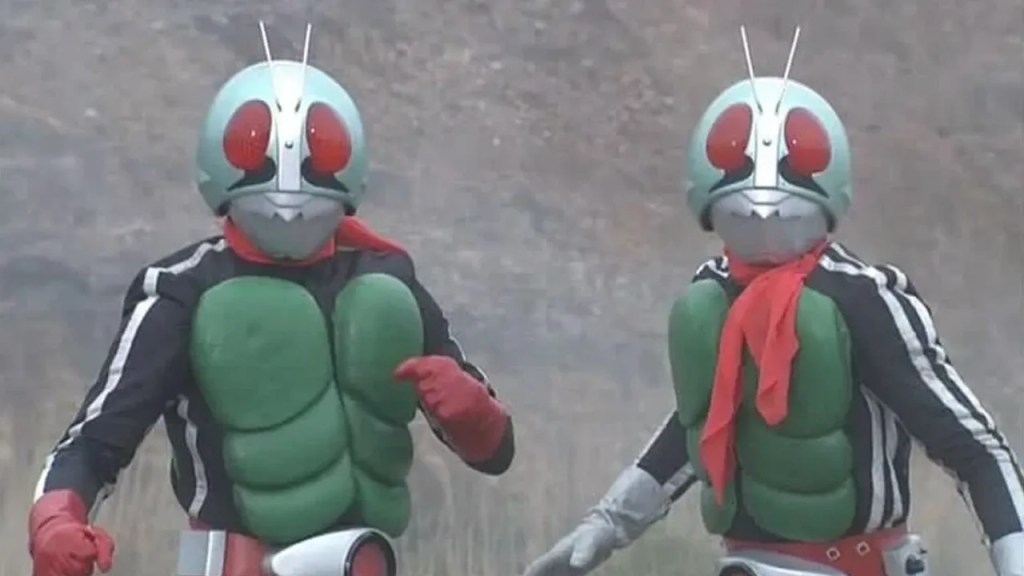
Kamen Rider‘s Legacy Has Influenced Multiple Franchises
Late Shotaro Ishinomori is considered a father figure in the tokusatsu genre. These are Japanese television programs that specialize in practical special effects. He is also regarded as the “King of Manga” and a father figure in Japanese Superhero fiction. Ishinomori created the Kamen Rider series that has been ongoing for more than 50 years. His masterpiece has influenced multiple series in the anime and tokusatsu genres, leaving behind a legacy. Ishinomori created the Super Sentai series, which is somewhat inspired by Kamen Rider.
Later on, Super Sentai became the foundation for Power Rangers, which defined a generation of children. Even though Ishinomori was not directly involved with the Power Rangers franchise, he was still credited as a co-creator. Even the anime industry has seen several references to Kamen Rider. Also, the franchise is always growing since the Reiwa era series, including modern technologies, digitalization, environmental consciousness, AI ethics, etc., to go forth with modernization.
Yokusaru Shibata’s creation, Tojima Wants to Be a Kamen Rider, is a direct reference to the original series. Due to the manga’s popularity, it has been adapted into an anime, which is scheduled to release in Fall 2025. The story follows 40-year-old Tojima Tanzaburo, who wants to fulfill his wish of becoming a Kamen Rider. Another reference to the Kamen Rider is One Punch Man’s Mumen Rider, who is a hero riding on a bicycle.
Also Read: The Legend of Anpanman – Japan’s Most Beloved Symbol of Heroism
Kamen Rider’s Origin
Shouwa Era
The first Kamen Rider series began on April 3, 1971, with Toei producer Toru Hirayama and Shōtō Ishinomori collaborating on a “Masked Hero Project.” It marked the beginning of the Shouwa Era of Kamen Rider. Hiroshi Fujioka played the role of Takeshi Hongo/Kamen Rider for a few episodes. Unfortunately, after suffering from an accident, he was replaced by Takeshi Sasaki’s Hayato Ichimonji/Kamen Rider 2.
After the former’s recovery, he was reintroduced and took over the character. Several episodes featured the two Kamen Riders uniting to defeat the antagonist. The first series concluded after 98 episodes, and subsequently, multiple series were aired after that.
Heisei Era
The Heisei Era is divided into two parts, beginning with Toei Company’s Kamen Rider Kuuga, which began airing from January 30, 2000. However, before the series officially aired, Shoto Ishinomori passed away. The series was based on Kamen Rider’s revival on its 30th Anniversary by Shoto Ishinomori. Heisei Era Phase 1 saw more Kamen Rider Series than the Shouwa Era, and concluded on August 30, 2009.
Heisei Era Phase 2 commenced a week after Phase 1’s conclusion. Similar to Phase 1, Phase 2 also had ten Kamen Rider series, which concluded on August 25, 2019, with Kamen Rider Zi-O.
Reiwa Era
The Reiwa Era is the ongoing era of the Kamen Rider series. It began a few days after Heisei Era Phase 2’s conclusion. The first series of this era was Kamen Rider Zero-One, which aired on September 1, 2019. Currently, the seventh series of the Reiwa Era is ongoing. It is named Kamen Rider Zeztz, which began on September 7, 2025.
Since the beginning of the Kamen Rider Era, there have been multiple movies and television specials. A few of the popular ones are Kamen Rider vs. Shocker, Kamen Rider: The First, Kamen Rider: The Next, etc. (movies), and Ultraman vs. Kamen Rider, All Together! Seven Kamen Riders!!, This is Kamen Rider Black, etc. (television specials).
Popular Characters From The Franchise
The franchise has gifted popular characters like Shigeru Ju/Kamen Rider Stronger, who sets out on a path of vengeance after his friend’s death. He seeks help from the antagonist, Black Satan, who transforms him. Black Satan was responsible for his friend’s death, and Kamen Rider Stronger starts finding ways to defeat him. During his journey, he is joined by Electro-Wave Human Tackle, and together they take on Black Satan.
Kamen Rider vs. Shocker showcased one of the most popular evil organizations of the franchise. Even though Shocker was a terrifying organization, it was responsible for creating Kamen Rider 1 and 2. The Great Leader was its leader and had multiple kaijins under their command.
Kamen Rider Is A Cult Hero
Kamen Rider’s cult hero status did not happen in one day. It involves the creator redefining heroism and the audience acquiring the taste of a different hero through the decades. The first thing that Kamen Rider did was to revolutionize the notion of being a “Hero.” It portrayed cyborgs, who were partially monsters, as the heroes. While they fought to protect the people, they also showcased the dark and complex thought process of the antagonists. The transformation of the Kamen Rider was a catchy thing, and everyone soon picked up the phrase “Henshin Boom.”
It did not stick to a single genre and explored new genres, allowing it to widen its audience reach. The references in other shows and anime also helped it become more popular. The concept of transformation was later adapted in popular anime, like Sailor Moon, Power Rangers, Ultraman, etc. Kamen Rider made computer graphics more relevant since special effects in Japanese television were rare. Their signature move, the “Rider Kick,” required significant effects to make it more appealing.
Kamen Rider withstood the test of time, inspired heroism, and also made modern alterations to the Japanese entertainment industry. Even though Kamen Rider is not perfect, it still chooses to fight for humanity irrespective of the threat’s magnitude. Every age group is a fan of the franchise due to its enduring appeal, action-packed choreography, transformation, etc.

Priyanko is currently pursuing his Master’s in Economics. He loves to read manga or watch anime in his spare time. He is a massive fan of One Piece, Naruto, and Haikyu. Amidst the Great Pirating Era, he wishes to become the greatest Hokage, even though he is short.
Leave a Reply