

 Add as a preferred source on Google
In the world of Dr. Stone, science often gets a stylish, fast-forward makeover. Episode 18 of Dr. Stone: Science Future gives us one of those moments where real-world chemistry is simplified into a punchy recipe: take alcohol, pass electricity through a tungsten filament, and “we’re making diamonds!” It’s a brilliant storytelling trick that sparks curiosity, but how close is this anime shortcut to the actual science of diamond-making?
Dr. Stone Anime Shortcut to Diamonds
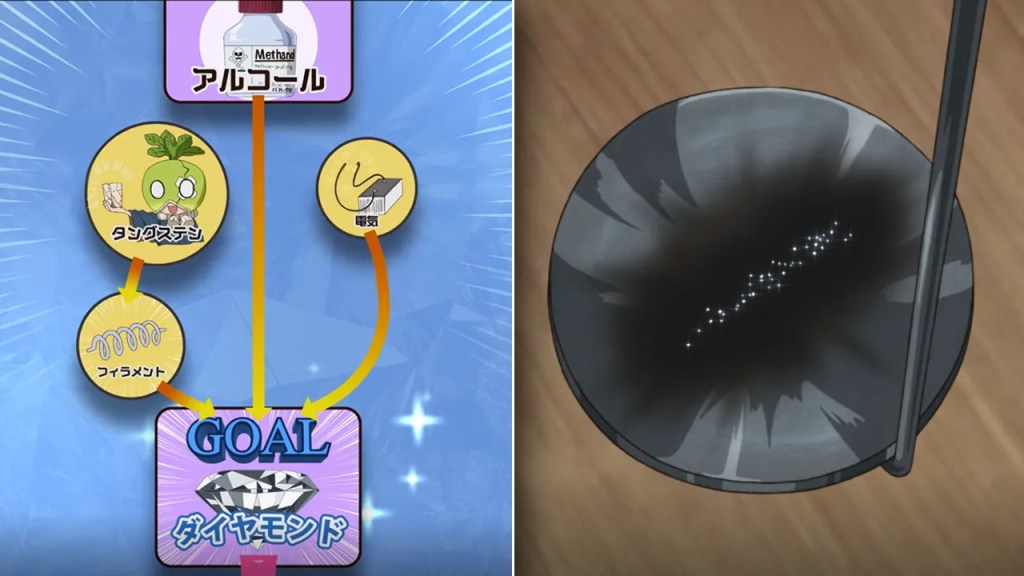
The breakdown lists some of the ingredients:
- Alcohol as the carbon source
- Tungsten filament heated with electricity
- A chamber-like setup where the reaction happens
This is essentially an anime version of the Chemical Vapor Deposition (CVD) method. In reality, the carbon in alcohol (ethanol or methanol) can, under certain conditions, be broken down and deposited onto a substrate. The filament, glowing at high temperatures, helps crack the carbon molecules, leaving atoms behind to build up crystalline structures. In Dr. Stone, that process is compressed into a dramatic moment, cutting straight to the punchline: Diamonds.
How Real Diamonds Are Made in Labs
In laboratories, synthetic diamonds are produced using advanced, resource-intensive techniques. The two most widely used are High Pressure High Temperature (HPHT) and Chemical Vapor Deposition (CVD).
HPHT replicates the natural conditions under which diamonds form deep in the Earth. Carbon is subjected to pressures over 50,000 atmospheres and temperatures surpassing 1300 degrees Celsius until it crystallizes into diamond.
CVD, the method closest to what we see in the anime, uses gases like methane and hydrogen in a vacuum chamber. Microwaves or a heated tungsten filament break the gases apart, allowing pure carbon atoms to settle onto a seed crystal and slowly grow a diamond layer. The process takes hours to weeks, depending on the size and quality of the diamond.
Researchers have also explored experimental methods, from explosive detonations that create nanodiamonds to liquid metal catalysts capable of producing diamond films in less than three hours. But all of them demand controlled conditions and precision engineering, far beyond a quick anime experiment.

Anime vs. Reality: A Spark of Science
So, can alcohol and a tungsten filament really make diamonds? In principle, yes, alcohol contains carbon, and under the right thermal conditions, those carbon atoms can deposit on a substrate. But the method Dr. Stone shows is more of a conceptual nod to the science rather than a practical demonstration. In reality, you’d need a sealed vacuum chamber, carefully balanced gas ratios, stable temperatures, and lots of time.
What Dr. Stone does exceptionally well, however, is distill a complex scientific concept into an instantly graspable idea. It sparks curiosity without overwhelming viewers with jargon. For a series that aims to celebrate science as much as storytelling, that balance is exactly the point.
Also Read: Top 6 Inventions That Changed the Game in Dr. Stone Anime
Source: International Gem Society, Wikipedia on Synthetic Diamond, Dr. Stone Season 4 Episode 18

A self-proclaimed pseudo-hikikomori and anime content glutton, Bhavya spends his time immersed in the shonen and isekai worlds of anime, always on the hunt for the next series to binge or dissect. Having worked as a cinematographer and graphic designer, he brings a creative eye and technical expertise to his passion for storytelling.
Leave a Reply